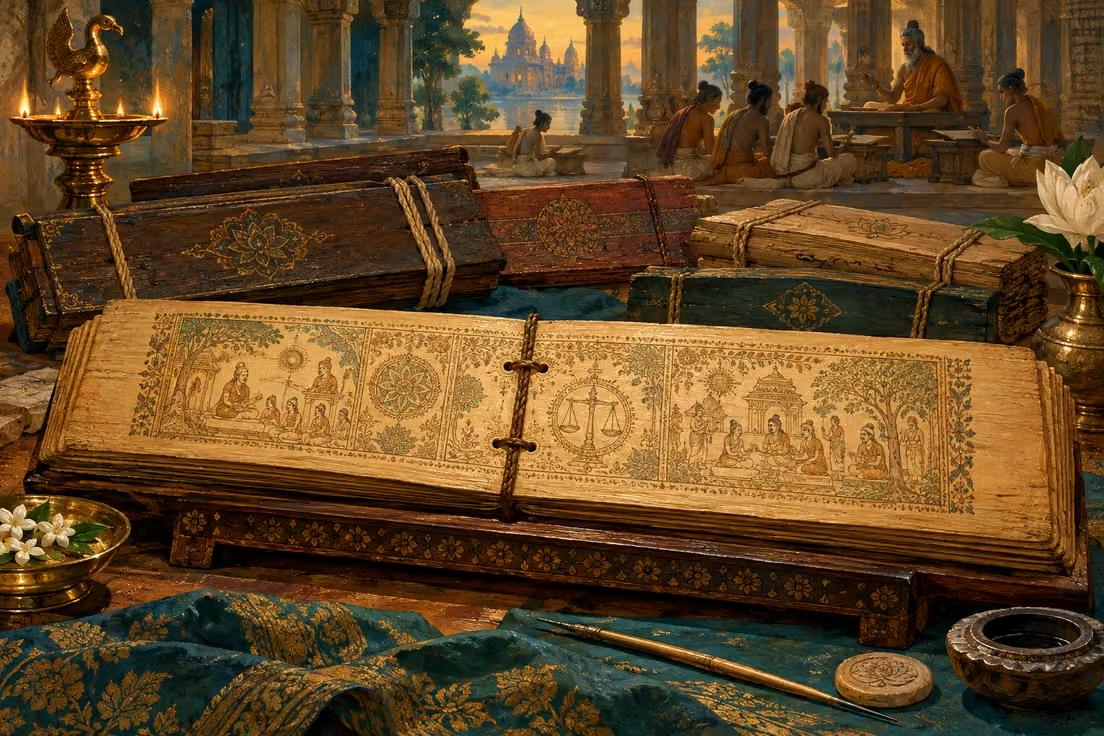
THE SACRED LIBRARY
About Smriti & Dharmashastra
A traditional formulation distinguishes the Veda as Shruti from the remembered institutes of dharma as Smriti. The distinction places later instruction in relation to a foundational sacred authority. It does not imply that every Smriti work has the same organization or gives an identical answer to every question.
The field combines matters that a modern reader may separate into religion, ethics and law. Rules for study and ritual can stand beside inheritance, debt, evidence and the king’s duties. Understanding that breadth is necessary before calling the entire body either a purely spiritual manual or a modern civil code.
More About Smriti & Dharmashastra
Literature of dharma, social duties, jurisprudence and religious conduct.
AT A GLANCE
Identity & Context
- Identity
- Text
- Tradition
- Hindu religious traditions
INSIDE THE TEXT
Stories & Teachings
ROLE & ESSENCE
Themes & Meaning
These works connect religious authority with the organization of social life. They discuss education and ritual alongside debts, property, evidence and the king's duties. They also prescribe unequal treatment based on birth, status and gender, making their social assumptions an important part of understanding what they teach.
Library Category
Smriti & Dharmashastra
Form
Parent group, not a single book
Scope
Literature of dharma, social duties, jurisprudence and religious conduct.
Reading Approach
Open a work below and identify its recension, translator and commentary.
Archive Classification Notes
Original archive annotations are retained here. The current playable classification is shown in the side panel.
- Tradition Dependence
- High — compare the identified textual or regional account.
TRADITION & MEANING
Traditions & Interpretations
These are prescriptive works: they set out rules and ideals rather than documenting every community's actual practice. Different schools and interpreters preserve disagreements, and their prescriptions do not demonstrate uniform observance throughout history.
The judicial passages make wrongdoing a responsibility of the court as well as the litigants. An unjust ruling can implicate the ruler, judges and witnesses. Alongside rules for disputes, this explains why the qualifications and conduct of those administering justice receive attention within the wider teaching on Dharma.
From the Sacred Texts
Explore the sacred texts behind these stories in the Suvarnaveda library.
FOLLOW THE THREADS
Connected Cards
12 connected profiles. Every path leads to an original record.
The Sacred Library12

Manusmriti is one major work in the dharma tradition.

Yajnavalkya’s teaching belongs to the Smriti literature on dharma.

Narada’s work specializes in the judicial dimension of dharma.



The fragments belong to the legal teaching of the Smriti tradition.

Katyayana’s legal teaching belongs to Smriti and Dharmashastra.

Smriti is distinguished from Shruti in traditional accounts of dharma.

Apastamba preserves a distinct sutra teaching on dharma.

Baudhayana’s instruction belongs to the wider literature on dharma.

Gautama preserves a distinct teaching on dharma.

Vasishtha’s work is a distinct account of dharma and conduct.