 Cosmic principle
Ultimate reality underlying existence in Vedantic discourse
Brahman
Brahman — Ultimate reality underlying existence in Vedantic discourse; distinct from the creator Brahma.
#1 / 929
Preparing the next part of Suvarnaveda.
The divine
Beings, divine forms, sages and epic figures. The editorial power roster contains 720 ranked entries.
929 Characters · 929 Ranked Beings
Open Advanced ExplorerCosmic principleUltimate reality underlying existence in Vedantic discourse
Brahman — Ultimate reality underlying existence in Vedantic discourse; distinct from the creator Brahma.
 Cosmic principle
Supreme Self or indwelling divine presence
Paramatman — Supreme Self or indwelling divine presence; its relation to Brahman and personal deity depends on school.
 Cosmic principle
Term for the personal divine or Lord possessing fullness of divine excellences
Term for the personal divine or Lord possessing fullness of divine excellences; not a single universally separate person.
 Cosmic principle
Lord or governing divine principle
Lord or governing divine principle; identity and status vary by philosophical and devotional tradition.
 Cosmic principle
Primordial Shakti understood as the source of divine power
Primordial Shakti understood as the source of divine power, especially in Shakta traditions.
 Cosmic principle
Great divine power or Shakti
Great divine power or Shakti; frequently overlaps with Adi Shakti and Mahadevi rather than constituting a separate being.
 Cosmic principle
Cosmic Person in Vedic imagery and conscious principle in Samkhya
Cosmic Person in Vedic imagery and conscious principle in Samkhya; distinguish these meanings.
 Cosmic principle
Primordial nature or material principle
Primordial nature or material principle; relationship to divinity and consciousness differs across philosophical schools.
 Cosmic principle
Power of manifestation or appearance
Power of manifestation or appearance; meanings include divine potency and the conditions of misapprehension.
 Cosmic principle
Cosmic time
Cosmic time, sometimes personified; distinguish time as principle from particular divine forms.
 Cosmic principle
Cosmic and ethical order
Cosmic and ethical order; distinct uses include a principle and a personified deity.
 Cosmic principle
Cosmic Intelligence
Mahat is the great principle of cosmic intelligence: the first differentiation of Prakriti in the creation sequence described by the Vishnu Purana and Samkhya. It makes ordered manifestation possible before Ahamkara, the senses and the elements emerge.
 Cosmic principle
The Principle of Individuation
Ahamkara is the principle of individuation or I-making. In Samkhya and related Puranic creation accounts, it develops from Mahat and supports the differentiation of sensory faculties and material elements. Its meaning is wider than ordinary pride or vanity.
 Cosmic principle
The Faculties of Perception and Action
The Indriyas are the faculties through which embodied beings perceive and act. Samkhya’s elevenfold group comprises five perceptive faculties, five active faculties and Manas, the mind that coordinates both. They form a distinct development from Ahamkara alongside the five Tanmatras.
 Cosmic principle
The Five Subtle Qualities
The Tanmatras are the five subtle principles of sound, touch, visible form, taste and smell. In Samkhya and related Puranic accounts, they emerge through Ahamkara and provide the subtle basis from which the five gross elements develop.
 Cosmic principle
Space, Air, Fire, Water and Earth
The Pancha Mahabhutas are the five gross elements: Akasha, Vayu, Tejas or Agni, Apas, and Prithvi—space, air, fire, water and earth. They are the differentiated elemental constituents of the embodied world in Samkhya and Puranic cosmology.
 Cosmic principle
Golden embryo or germ associated with cosmic emergence
Golden embryo or germ associated with cosmic emergence; later identifications vary.
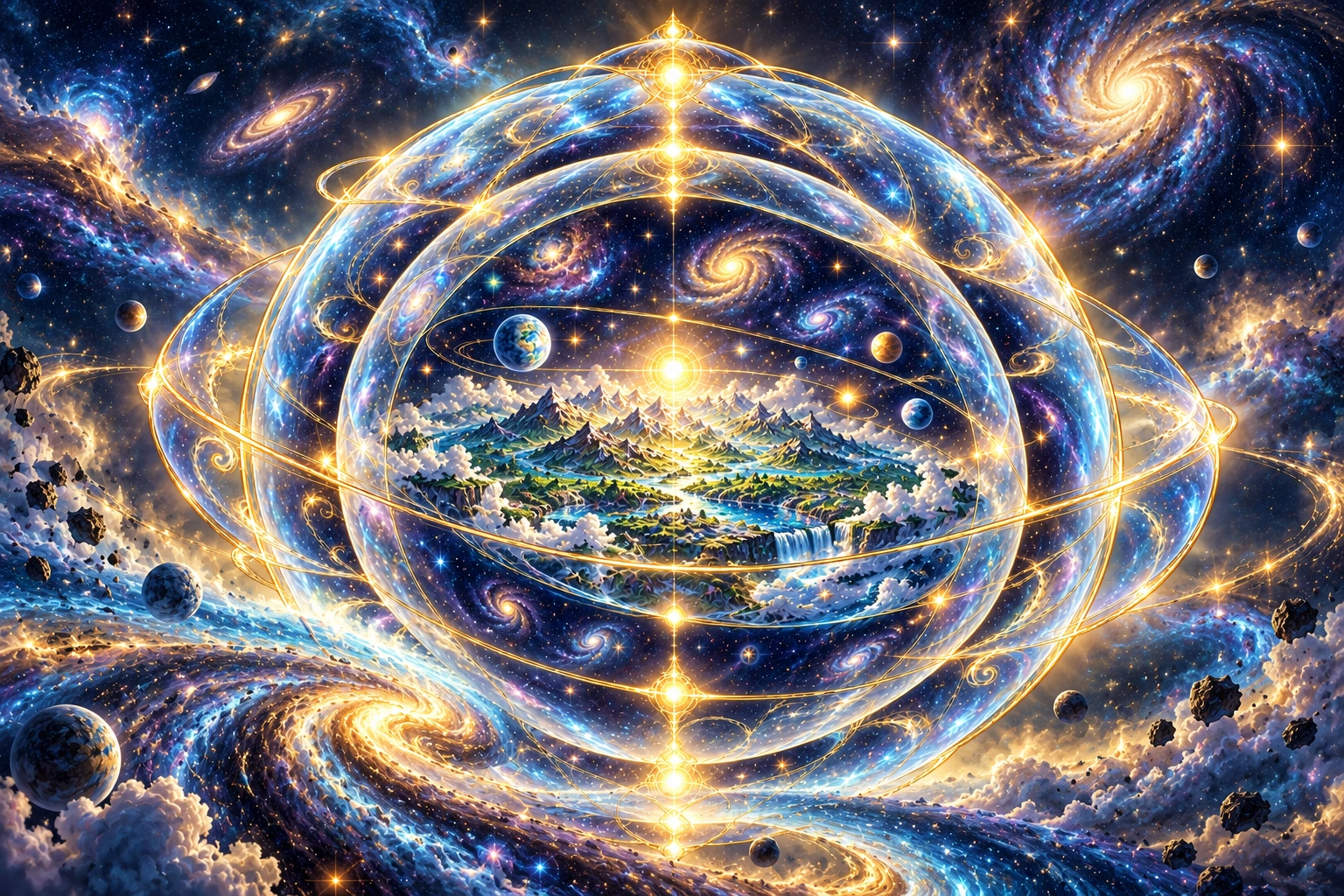 Cosmic principle
The Manifested Cosmic Universe
Brahmanda is the cosmic egg: the enclosed, manifested universe described in Puranic cosmology. Mountains, oceans, worlds, celestial bodies and living beings belong within it, while successive enclosing layers place the formed cosmos within a larger account of creation.