THE WORLDS
About Plaksha Dvipa
Idhmajihva, a son of Priyavrata, rules this land in that account. He distributes its seven regions among his sons before retiring into spiritual practice. The geography thus includes a succession story: ordered government is established, then the ruler turns away from possession toward contemplation.
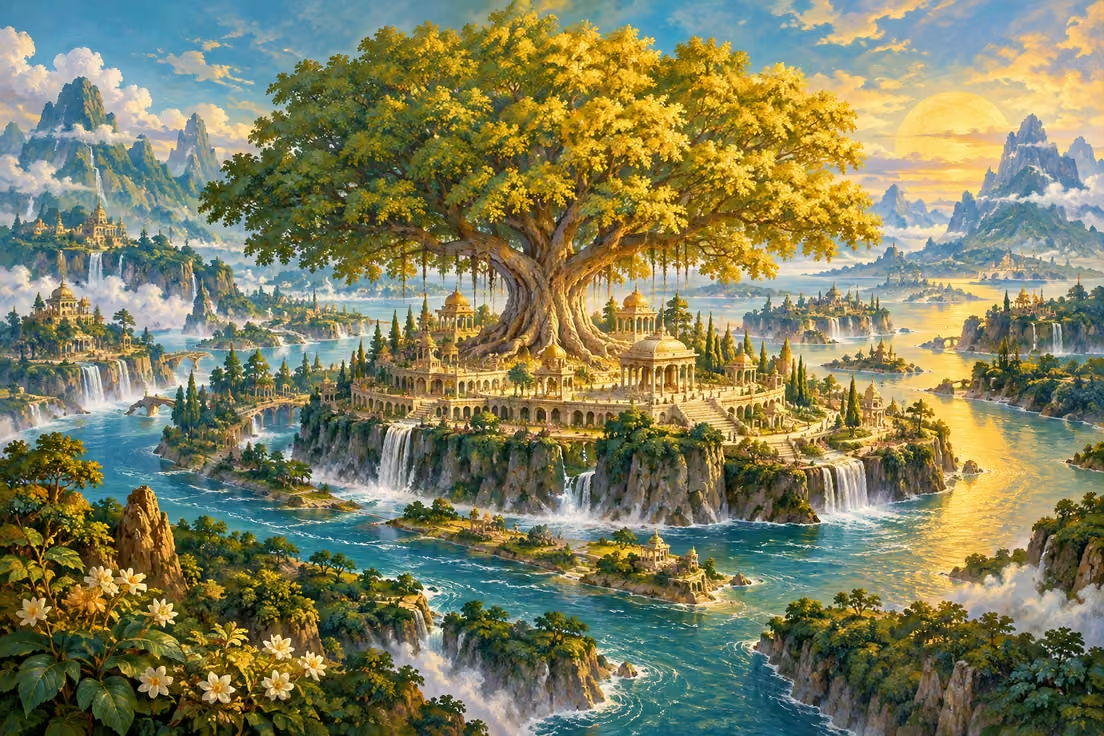
A seven-flamed fire stands at the great tree’s root. The surrounding rivers and mountains give the seven regions their boundaries and sacred character. The inhabitants worship the divine through the sun, whose radiance is presented as an expression of a greater sustaining presence.
More About Plaksha Dvipa
A dvipa beyond Jambudvipa in the seven-dvipa scheme, named for its sacred plaksha tree.
AT A GLANCE
Identity & Context
- Identity
- Realm
- Form
- Cosmic geography
- Tradition
- Hindu cosmological traditions
- World & Associations
- Cosmic geography
THE STORY
The Realm & Its Stories
ROLE & ESSENCE
Attributes & Significance
Plaksha introduces the outer dvipas as complete worlds with social orders, rivers, worship and royal histories. Its significance is not simply that it is larger than the preceding region. The tree, sevenfold division and solar devotion give it a recognizable identity within a repeated but varied cosmographic pattern.
Realm Category
Cosmic geography
Cosmological Position
Textual cosmography; no modern map coordinates assigned.
Ruler / Presiding Association
Inhabitants & Associated Beings
Environment & Landmarks
A dvipa beyond Jambudvipa in the seven-dvipa scheme, named for its sacred plaksha tree.
Atmosphere
An illustrative environment; artistic presentation is distinct from a textual description.
Access / Routes
Related realms below are conceptual reading paths, not physical travel routes.
Earthly Association
No physical geographical equivalence asserted.
Tradition Notes
Names and accounts can vary by recension, region and commentary. This entry distinguishes attested details from identifications still requiring a passage-level source.
Archive Classification Notes
Original archive annotations are retained here. The current playable classification is shown in the side panel.
- Tradition Dependence
- High — cosmological systems and supreme-abode theologies differ.
- Guardians
- Not established in the passage; no additional claim is made here.
- Important Stories
- Not established in the passage; no additional claim is made here.
TRADITION & MEANING
Traditions & Interpretations
The Bhagavata describes Idhmajihva as ruler and the inhabitants' solar worship. The Vishnu Purana instead names Medhatithi and worship associated with Soma. They are different versions of the island's royal and devotional setting.
Plaksha combines a defining tree with seven regions, a succession through Idhmajihva's sons and worship associated with the Sun. The sugarcane ocean marks its outer boundary before Shalmala. These features explain both the inhabitants' life within the land and the island's place in the wider sequence.
Names and accounts can vary by recension, region and commentary. This entry distinguishes attested details from identifications still requiring a passage-level source.
From the Sacred Texts
Explore the sacred texts behind these stories in the Suvarnaveda library.
FOLLOW THE THREADS
Connected Cards
4 connected profiles. Every path leads to an original record.
Realms & Cosmic Worlds2
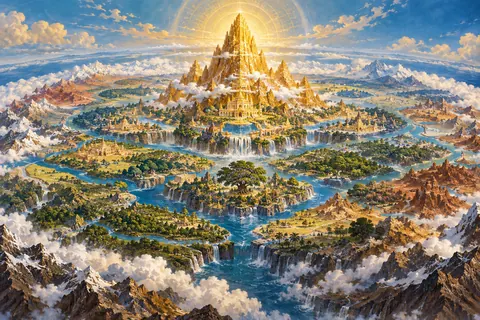
Plaksha lies beyond the salt ocean surrounding Jambudvipa.

Shalmala follows the ocean surrounding Plaksha.
Characters & Cosmic Entities2

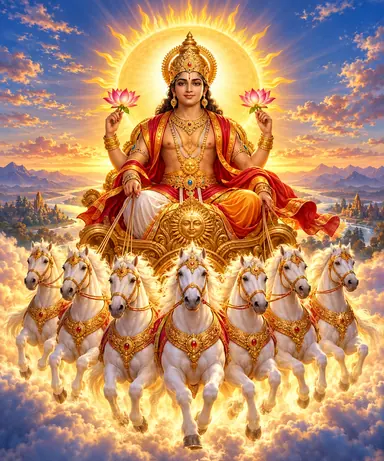
The Bhagavata’s inhabitants worship through the solar divine form.