
THE SACRED LIBRARY
About Mundaka Upanishad
The work has three Mundakas, each containing two sections. It opens with a teaching lineage beginning with Brahma and passing through Atharvan and other teachers before introducing Shaunaka’s question. The question does not ask for every separate fact in the world, but for knowledge of the reality upon which its many forms depend.
More About Mundaka Upanishad
The distinction between higher and lower knowledge frames teachings on Brahman and realization.
AT A GLANCE
Identity & Context
- Identity
- Text
- Form
- Shruti
- Tradition
- Hindu religious traditions
INSIDE THE TEXT
Stories & Teachings
ROLE & ESSENCE
Themes & Meaning
The Mundaka is important for its direct distinction between extensive learning and realization of the imperishable. Its examples explain dependence, concentration and release through familiar activities. The bow comparison concerns the discipline of contemplation, not a spiritual weapon to be used against another person.
Library Category
Form / Textual Family
Upanishad
Traditional Attribution
An inherited textual tradition; no single historical author is established here.
Subject & Teachings
The distinction between higher and lower knowledge frames teachings on Brahman and realization.
Associated Deities / Figures
Textual Relationships
Historical Context
Composition, transmission and redaction must be distinguished; no unsupported exact date is assigned.
Reading Notes
Read the Sanskrit with an identified translation. Commentary is presented by its own school, not as the only interpretation.
Tradition Notes
Names and accounts can vary by recension, region and commentary. This entry distinguishes attested details from identifications still requiring a passage-level source.
Archive Classification Notes
Original archive annotations are retained here. The current playable classification is shown in the side panel.
- Tradition Dependence
- High — compare the identified textual or regional account.
- Structure
- Consult the identified edition for chapters, recension and numbering.
TRADITION & MEANING
Traditions & Interpretations
Brahma, the divine teacher in the opening lineage, is distinct from Brahman, the imperishable reality the teaching investigates. Later Vedanta schools also interpret the relation of the individual self and Brahman differently. The text’s comparisons remain central to those interpretations without requiring every school to give them the same conclusion.
Names and accounts can vary by recension, region and commentary. This entry distinguishes attested details from identifications still requiring a passage-level source.
From the Sacred Texts
Explore the sacred texts behind these stories in the Suvarnaveda library.
FOLLOW THE THREADS
Connected Cards
6 connected profiles. Every path leads to an original record.
The Sacred Library3


Traditional commentary reads the two Atharvavedic works in relation.
Characters & Cosmic Entities3

Angiras teaches Shaunaka in the opening dialogue.

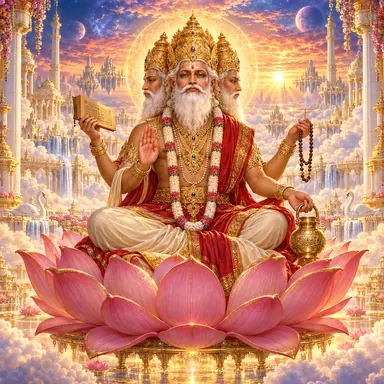
The opening traces the teaching’s lineage to Brahma.