
THE LIVING ARCHIVE
About Saraswati
The hymns describe a forceful course associated with mountains and nourishing abundance. They also ask her favour in worship and speech. The water’s presence and the deity’s intellectual power are already connected in the early poetry.
One hymn calls her seven-sistered, placing her within a wider sacred community of rivers. This image does not by itself identify a complete biological family or settle the names of modern river channels.
AT A GLANCE
Identity & Context
- Identity
- Deity
- Form
- Sacred river personification
- Tradition
- Vedic · Puranic
- Also Known As
- Sarasvati (river)
- World & Associations
- Saraswati river; sacred geography varies
The personified river identity in this record; other Saraswati manifestations remain separate.
Family Context
The available reference record does not establish a complete family genealogy. No parents, consorts, or descendants are inferred from the name alone.
THE STORY
Life & Stories
Story Connections
- Saraswati river hymns and sacred geography
ROLE & ESSENCE
Attributes & Significance
Saraswati’s hymns show that river and goddess are not unrelated subjects. People praise the same presence on which they depend for nourishment and from which they seek understanding, protection and a stable home.
Role
River-personification entry for Saraswati; distinguish river, Vedic deity, and later goddess-of-learning contexts.
Attributes & Abilities
- Sacred river power
TRADITION & MEANING
Traditions & Interpretations
Her historical geography and the later development of her imagery raise additional questions. The hymns do not conclusively settle a disputed modern river identification.
The relationship includes dependence, fear, praise and friendship. Reading those together explains how a sacred landscape becomes more than scenery in the religious life of a community.
Artwork & Archive Notes
Objects & Emblems
No named weapon or artifact is specified in this profile’s reference record. This does not establish that the figure never used one.
Visual Identity
Where artwork is shown, it is a contemporary illustrative interpretation. This reference record does not establish a fixed portrait, colour scheme, or complete set of iconographic attributes for this figure.
Tradition Note
The accounts belong to Vedic / Puranic. Genealogy, theological interpretation, and portrayal can differ between texts and regional retellings.
FOLLOW THE THREADS
Connected Cards
11 connected profiles. Every path leads to an original record.


Characters & Cosmic Entities9

Tara is praised as Nila Sarasvati in the Brihannila tradition.

Bhairavi’s praise identifies her with the source of speech and invokes Sarasvati.
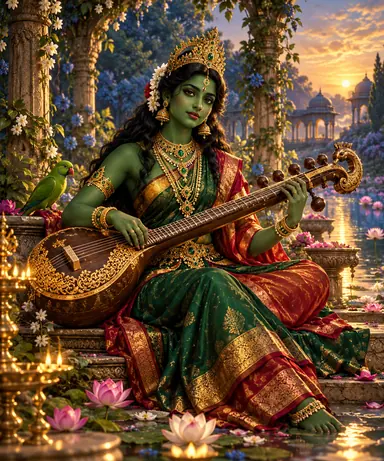
Matangi’s book, music and speech associations create a close thematic relationship with Saraswati.

The expanded title is connected with Saraswati while its narrative and iconographic scope is specific.

Vashishtha’s hymn seeks Saraswati’s protection and strength.

Saraswati’s gift of prosperity is compared with Pushan’s help.

Sarasvati appears in the Vishvarupa age before the account of Ishana’s manifestation.

Sindhu and Sarasvati are invoked together as sacred waters.

Sarasvati is praised in the sixth mandala’s Bharadvaja collection.