
THE LIVING ARCHIVE
About Hastinapura
Hastinapura is distinct from Indraprastha, the new capital the Pandavas establish after the kingdom is divided. Their shared family background connects the two courts, but the separation creates different centres of rule in an attempt to contain rivalry within the dynasty.
The capital's people also have a role in the story. They come out to see the returning Pandavas and express affection and hopes for protection. Their welcome connects the princes with the responsibilities expected of rulers, beyond the interests of the royal household.
More About Hastinapura
The Kuru capital in the Mahabharata; the modern town preserves the traditional name and association.
AT A GLANCE
Identity & Context
- Identity
- Location
- Form
- Mahabharata geography
- Tradition
- Hindu religious traditions
THE STORY
Origins & Stories
ROLE & ESSENCE
Attributes & Significance
Hastinapura is a place where decisions about the dynasty affect the wider kingdom. The partition attempts to manage family rivalry by distributing territory. The dice game then places royal resources and people at risk through another court decision. The citizens' expectation of protection stands beside the ruling family's repeated failure to contain its conflict.
Ancient / Sacred Name
Hastinapura
Modern Identification
Hastinapur, Uttar Pradesh, India
Identification Confidence
Strong traditional identification
Country / Region
Hastinapur, Uttar Pradesh, India
Kingdom / Dynasty
Kuru dynasty
Associated Figures
Sacred Significance & Narrative
The Kuru capital in the Mahabharata; the modern town preserves the traditional name and association.
Events / Battles
See the linked narrative records.
Historical / Archaeological Evidence
This overview does not identify a site-specific excavation report. A living physical place does not prove every event traditionally associated with it.
Textual Geography Notes
Ancient regions, literary geography and modern pilgrimage identifications are distinguished.
Tradition Notes
Names and accounts can vary by recension, region and commentary. This entry distinguishes attested details from identifications still requiring a passage-level source.
Archive Classification Notes
Original archive annotations are retained here. The current playable classification is shown in the side panel.
- Tradition Dependence
- High — compare the identified textual or regional account.
TRADITION & MEANING
Traditions & Interpretations
The welcome and the partition take place within the same return to Hastinapura. The brothers receive public affection yet are directed to rule elsewhere, showing how the court tries to accommodate their claim while keeping rival branches of the family apart.
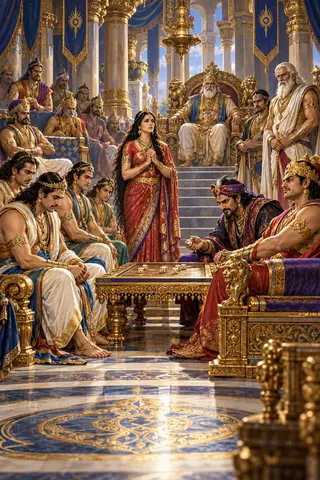
The dice game's list of stakes explains the scale of the disaster. Yudhishthira risks the goods, animals and dependants that support a royal household, so Shakuni's victories affect more than personal possessions or pride.
The epic's capital, the historical settlement and present-day identifications require different kinds of evidence. Its court scenes do not provide a complete archaeological chronology or a measured reconstruction of the palace.
Names and accounts can vary by recension, region and commentary. This entry distinguishes attested details from identifications still requiring a passage-level source.
From the Sacred Texts
Explore the sacred texts behind these stories in the Suvarnaveda library.
FOLLOW THE THREADS
Connected Cards
9 connected profiles. Every path leads to an original record.
Characters & Cosmic Entities5

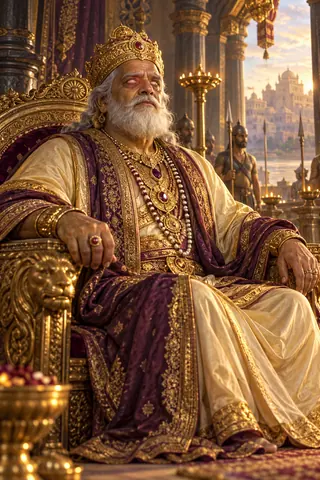


Yudhishthira returns to the ancestral court before the partition.

Shakuni conducts the deceitful game against Yudhishthira.
The Sacred Library1

Stories & Events1
Weapons1

Balarama threatens to draw Hastinapura into the river.
Earthly Sacred Locations1

Indraprastha grows from the division arranged at Hastinapura.