THE WORLDS
About Raurava
The description begins with a person strongly attached to bodily identity and the idea of what is mine. While maintaining himself and his family, he harms others. The narrative does not condemn family care by itself; its concern is the use of that care as a justification for injury.
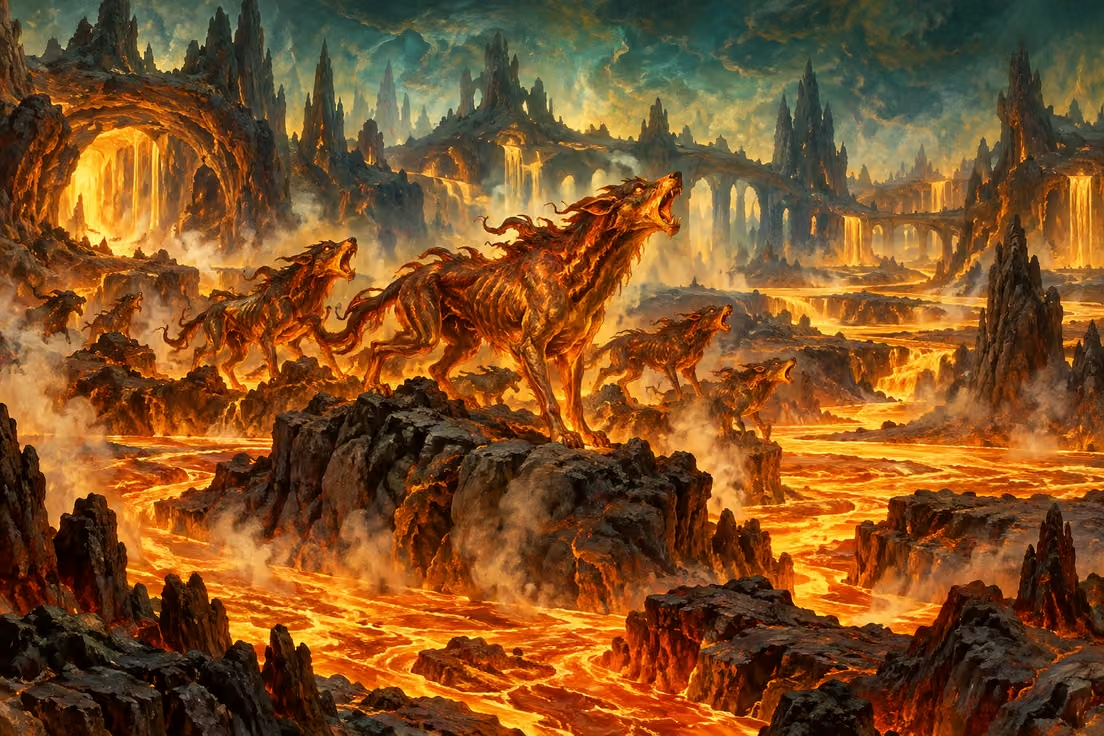
The beings previously injured by the wrongdoer return as rurus and inflict suffering on him. They belong to this supernatural punishment narrative. Raurava's name is distinct from Ruru, the personal name borne by other figures in sacred stories.
More About Raurava
A named Naraka in Bhagavata 5.26, connected with the consequences of harming other beings.
AT A GLANCE
Identity & Context
- Identity
- Realm
- Form
- Judgement realms
- Tradition
- Hindu cosmological traditions
- World & Associations
- Judgement realms
THE STORY
The Realm & Its Stories
ROLE & ESSENCE
Attributes & Significance
Raurava expands the moral field beyond exclusive concern for family advantage. It asks what happens when the interests of one household become permission to injure everyone outside it. The rurus make that hidden cost visible, giving the realm an ethical identity rather than defining it only through frightening appearance.
Realm Category
Judgement realms
Cosmological Position
Judgement realms
Ruler / Presiding Association
Inhabitants & Associated Beings
Guardians
Yama’s messengers, in judgement accounts.
Environment & Landmarks
A named Naraka in Bhagavata 5.26, connected with the consequences of harming other beings.
Atmosphere
A restrained reading of the text’s moral imagery; no Western hell imagery.
Access / Routes
Related realms below are conceptual reading paths, not physical travel routes.
Earthly Association
No physical geographical equivalence asserted.
Tradition Notes
Names and accounts can vary by recension, region and commentary. This entry distinguishes attested details from identifications still requiring a passage-level source.
Archive Classification Notes
Original archive annotations are retained here. The current playable classification is shown in the side panel.
- Tradition Dependence
- High — cosmological systems and supreme-abode theologies differ.
- Important Stories
- Not established in the passage; no additional claim is made here.
TRADITION & MEANING
Traditions & Interpretations
The same Bhagavata list describes Maharaurava separately and gives it related flesh-eating creatures. Raurava and Maharaurava therefore share a concern with harmful self-interest but have their own named descriptions.
The concluding framework treats punitive destinations as consequences within continued existence and eventual rebirth. Raurava’s particular force is the recognition of injured others. It belongs to a religious narrative of accountability, while its imagery remains distinct from the jewelled Naga worlds that also appear in Puranic lower-world geography.
Names and accounts can vary by recension, region and commentary. This entry distinguishes attested details from identifications still requiring a passage-level source.
From the Sacred Texts
Explore the sacred texts behind these stories in the Suvarnaveda library.
FOLLOW THE THREADS
Connected Cards
4 connected profiles. Every path leads to an original record.
Characters & Cosmic Entities1
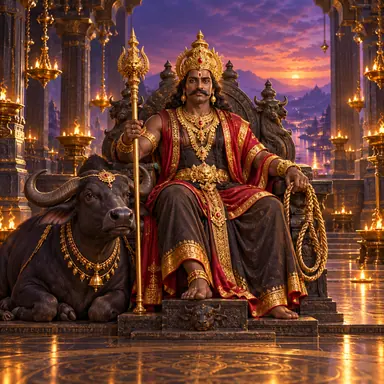
Yama assesses the conduct assigned to these environments.
Realms & Cosmic Worlds3


Raurava also centres on the return of suffering caused to other beings.

Raurava also connects violence with its return through ruru beings.