THE WORLDS
About Yamaloka
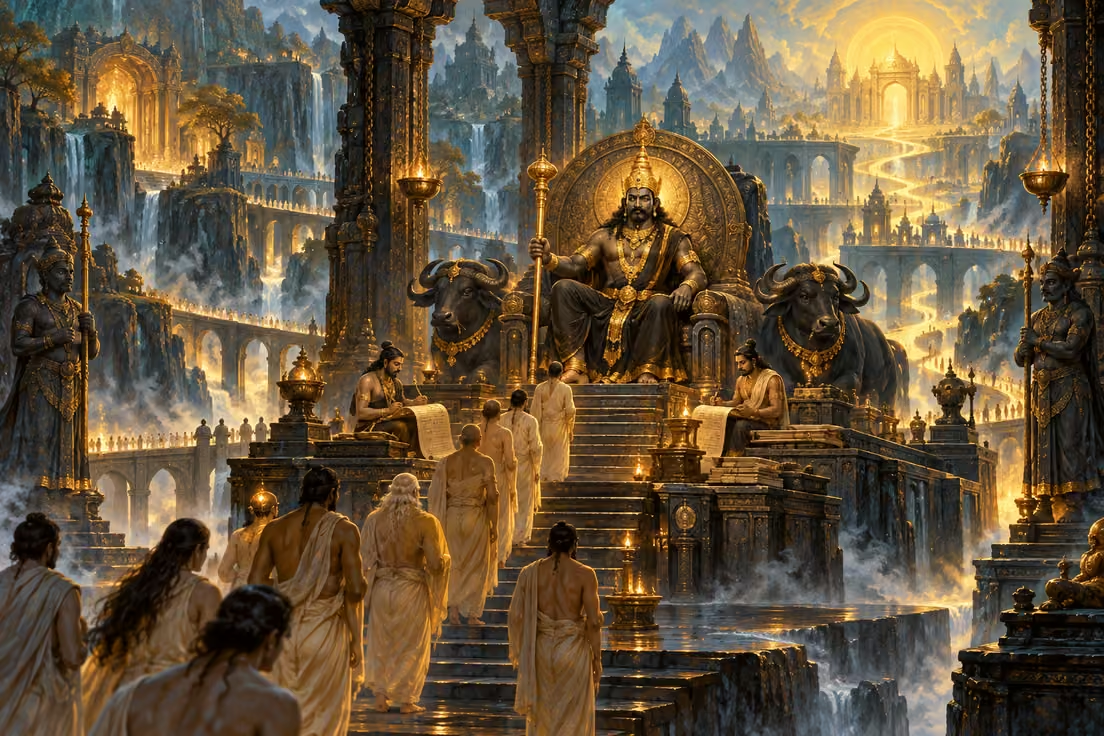
Yama is also called Vaivasvata, the son of the Sun, and ruler of the ancestral hosts. These roles connect judgment with a wider order of death and lineage. His domain is therefore more complex than an isolated dungeon, even when a story concentrates on the messengers who bring a wrongdoer before him.
The named punitive environments are destinations assigned within that judicial framework. Yamaloka identifies the lord’s domain and authority; Tamisra, Avichi and the other Narakas identify particular conditions. Keeping the two levels distinct helps explain how the descriptions fit together.
AT A GLANCE
Identity & Context
- Identity
- Realm
- Form
- Judgement realms
- Tradition
- Hindu cosmological traditions
- World & Associations
- Judgement realms
THE STORY
The Realm & Its Stories
ROLE & ESSENCE
Attributes & Significance
The domain gives narrative form to a question that runs through many ethical stories: what remains when reputation, possessions and office can no longer protect a person? Yamaloka makes the answer depend on conduct and spiritual orientation, rather than treating death as a continuation of social privilege.
Realm Category
Judgement realms
Cosmological Position
Judgement realms
Ruler / Presiding Association
Inhabitants & Associated Beings
Guardians
Yama’s messengers, in judgement accounts.
Environment & Landmarks
Yama’s domain of justice and the assessment of deeds; the court is distinct from any one punitive Naraka.
Atmosphere
A restrained reading of the text’s moral imagery; no Western hell imagery.
Access / Routes
Related realms below are conceptual reading paths, not physical travel routes.
Earthly Association
No physical geographical equivalence asserted.
Tradition Notes
Names and accounts can vary by recension, region and commentary. This entry distinguishes attested details from identifications still requiring a passage-level source.
Archive Classification Notes
Original archive annotations are retained here. The current playable classification is shown in the side panel.
- Tradition Dependence
- High — cosmological systems and supreme-abode theologies differ.
- Important Stories
- Not established in the passage; no additional claim is made here.
TRADITION & MEANING
Traditions & Interpretations
Accounts differ in their descriptions of Yama's domain. The Bhagavata connects his ancestral kingship with judgment of particular deeds, while distinguishing ancestral hosts from the beings assigned to punitive Narakas.
Yama's ancestral title and his work as judge explain why several afterlife terms occur together. Pitrloka emphasizes the ancestors, Yamaloka his domain, and the Narakas the particular destinations of suffering. The Ajamila episode also explains a limit on his messengers' authority within the larger divine order.
Names and accounts can vary by recension, region and commentary. This entry distinguishes attested details from identifications still requiring a passage-level source.
From the Sacred Texts
Explore the sacred texts behind these stories in the Suvarnaveda library.
FOLLOW THE THREADS
Connected Cards
5 connected profiles. Every path leads to an original record.
Realms & Cosmic Worlds3

The domain of judgment is connected with, but not identical to, every ancestral destination.

Narakas are differentiated consequences within the wider account of judgment.

Characters & Cosmic Entities2
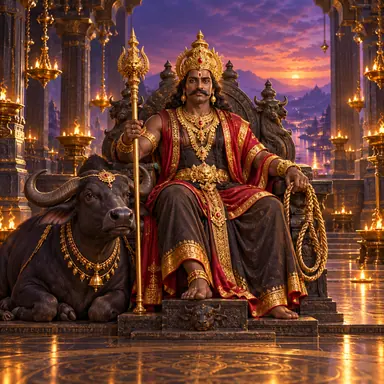
Yama is the authority from whom Yamaloka takes its name.
