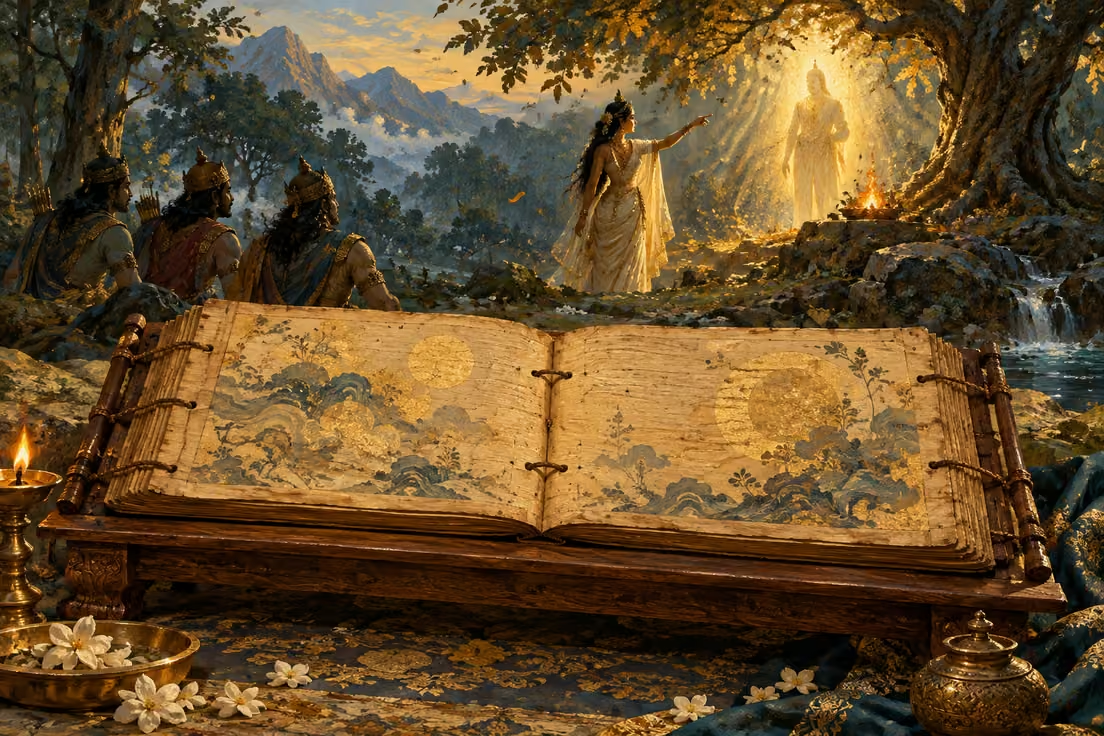
THE SACRED LIBRARY
About Kena Upanishad
Kena means by whom, recalling the opening question about the direction of mind and senses. The work is also associated with the name Talavakara. It combines short philosophical instruction with a prose account of the gods, using both forms to explain why the possession of a power does not fully explain its source.
Brahman is the fundamental reality being investigated, not simply the creator Brahma acting as another god in the assembly. The teaching concerns the basis of divine power as well as human experience. This distinction is important because the two names can look very similar in English.
More About Kena Upanishad
An inquiry into what impels mind, speech and the senses, followed by a teaching involving a mysterious yaksha.
AT A GLANCE
Identity & Context
- Identity
- Text
- Form
- Shruti
- Tradition
- Hindu religious traditions
INSIDE THE TEXT
Stories & Teachings
ROLE & ESSENCE
Themes & Meaning
The straw episode makes the philosophical point understandable through an unexpected failure. Agni and Vayu can describe what they usually do, yet cannot explain or command the power behind it. Indra receives an explanation through Uma, showing the importance of learning after confidence has proved inadequate.
Library Category
Form / Textual Family
Upanishad
Traditional Attribution
An inherited textual tradition; no single historical author is established here.
Subject & Teachings
An inquiry into what impels mind, speech and the senses, followed by a teaching involving a mysterious yaksha.
Textual Relationships
Historical Context
Composition, transmission and redaction must be distinguished; no unsupported exact date is assigned.
Reading Notes
Read the Sanskrit with an identified translation. Commentary is presented by its own school, not as the only interpretation.
Tradition Notes
Names and accounts can vary by recension, region and commentary. This entry distinguishes attested details from identifications still requiring a passage-level source.
Archive Classification Notes
Original archive annotations are retained here. The current playable classification is shown in the side panel.
- Tradition Dependence
- High — compare the identified textual or regional account.
- Structure
- Consult the identified edition for chapters, recension and numbering.
TRADITION & MEANING
Traditions & Interpretations
Uma reveals knowledge in this encounter. The story is connected with later Goddess traditions, while its immediate subject is the correction of the gods’ pride and their recognition of Brahman.
The opening and the story examine the same problem: an activity can be familiar without its deepest basis being understood. The teaching therefore distinguishes using a power from knowing what enables it.
Names and accounts can vary by recension, region and commentary. This entry distinguishes attested details from identifications still requiring a passage-level source.
From the Sacred Texts
Explore the sacred texts behind these stories in the Suvarnaveda library.
FOLLOW THE THREADS
Connected Cards
6 connected profiles. Every path leads to an original record.
The Sacred Library1

Characters & Cosmic Entities5

Brahman is the ground disclosed by the teaching.

Agni cannot burn the straw.

Vayu cannot lift the straw.

Indra hears Uma’s identification of Brahman.

Uma Haimavati reveals the source of the gods’ victory.