
THE LIVING ARCHIVE
About Uchchaihshravas
His origin belongs to the ocean's churning rather than a mortal stable or breeding line. He emerges among the extraordinary beings and treasures produced by that great effort.
In the Bhagavata account, Bali desires the horse. Indra refrains from opposing him because of prior divine instruction. This particular distribution of the treasure differs from a claim that every telling gives the horse the same owner.
AT A GLANCE
Identity & Context
- Identity
- Vahana
- Form
- Celestial mount
- Tradition
- Vedic · Puranic
- Also Known As
- Ucchaihshravas · Uchchaishravas
- World & Associations
- Celestial worlds
Family Context
The available reference record does not establish a complete family genealogy. No parents, consorts, or descendants are inferred from the name alone.
THE STORY
Life & Stories
ROLE & ESSENCE
Attributes & Significance
The same beauty has different consequences in the two episodes. The churning reveals an exceptional creature; the sisters' wager turns that creature's appearance into a means of deception.
Vinata's loss over the horse leads her son Garuda to seek divine nectar as the price of her release. Uchchaihshravas therefore connects the churning story with that later quest.
Role
Celestial horse emerging from the churning; possession varies by account.
Attributes & Abilities
- Celestial swiftness
TRADITION & MEANING
Traditions & Interpretations
Some artistic traditions portray him with additional heads. The emergence account used here describes his white colour and origin without specifying those features.
Different figures respond to the horse in different ways: Bali desires him, Krishna names him as an example of excellence, and Kadru manipulates what others see of him. His splendour connects these episodes, while their actions produce different results.
From the Sacred Texts
Explore the sacred texts behind these stories in the Suvarnaveda library.
Artwork & Archive Notes
Objects & Emblems
No named weapon or artifact is specified in this profile’s reference record. This does not establish that the figure never used one.
Visual Identity
Where artwork is shown, it is a contemporary illustrative interpretation. This reference record does not establish a fixed portrait, colour scheme, or complete set of iconographic attributes for this figure.
Tradition Note
The accounts belong to Vedic / Puranic. Genealogy, theological interpretation, and portrayal can differ between texts and regional retellings.
FOLLOW THE THREADS
Connected Cards
6 connected profiles. Every path leads to an original record.
Characters & Cosmic Entities4

Uchchaihshravas and Airavata appear successively among the churning’s treasures and hold distinct preeminence among horses and elephants.
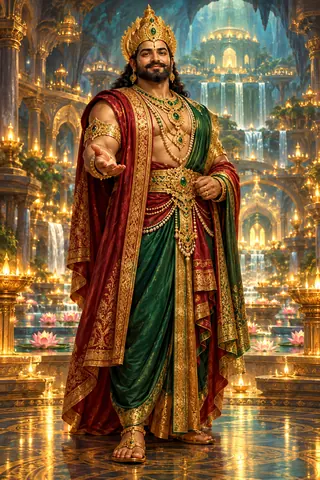
Bali desires the horse in the Bhagavata account.
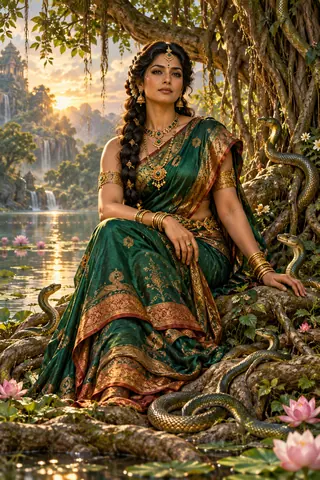
Kadru’s claim concerns the horse’s tail.
Vinata’s loss over the horse leads to bondage.