
THE LIVING ARCHIVE
About Airavata
Airavata is more than an unnamed animal beneath a deity. The Vishnu Purana names him king of elephants within an ordered creation in which different beings receive distinct spheres of authority. The Bhagavad Gita likewise singles him out among lordly elephants when Krishna describes exemplary manifestations of his splendor. These passages give Airavata a representative eminence alongside his familiar role as Indra's mount.
The Bhagavata's churning account describes his white appearance and four tusks, then mentions further groups of male and female elephants. Airavata is a particular being in that scene, not the collective name for every celestial elephant. He must also be distinguished from the serpent named Airavata in the Mahabharata's list of Kadru's offspring; a shared name does not make the elephant and the naga the same narrative creature.
AT A GLANCE
Identity & Context
- Identity
- Vahana
- Form
- Celestial mount
- Tradition
- Vedic · Puranic
- Also Known As
- Airavata (elephant)
- World & Associations
- Svarga
Family & Relationships
- Mount OfIndra
Family Context
These relationships follow the traditions described here. Some details remain uncertain and should not be treated as a single universal genealogy.
Airavata
Shared or similar name does not establish the same identity.
THE STORY
Life & Stories
Story Connections
- Ocean-churning emergence variants
- Indra's mount
ROLE & ESSENCE
Attributes & Significance
Airavata joins majesty with service: he is distinguished among elephants while carrying another sovereign through conflict and ceremony. The Gita's use of him as an example of divine splendor is an affirmation of eminence within a particular class. His role in the garland episode also shows how the smallest action surrounding a royal household can have consequences far beyond its immediate setting.
Role
Indra's celestial elephant; distinguish the Naga named Airavata.
Attributes & Abilities
- Celestial strength
TRADITION & MEANING
Traditions & Interpretations
Airavata’s white, four-tusked form belongs to a vision of celestial majesty. The garland episode and his presence beside Indra also connect him with the changing fortunes of heavenly kingship. The Naga named Airavata is a separate identity.
The four-tusked white form described here is the Bhagavata's depiction. The garland narrative and Govardhana visit are presented through the Vishnu Purana's own account and need not be forced into a single uninterrupted modern biography. The similarly named naga remains a separate figure: the serpent genealogy does not establish the celestial elephant's parentage.
From the Sacred Texts
Explore the sacred texts behind these stories in the Suvarnaveda library.
Artwork & Archive Notes
Objects & Emblems
No named weapon or artifact is specified in this profile’s reference record. This does not establish that the figure never used one.
Visual Identity
Where artwork is shown, it is a contemporary illustrative interpretation. This reference record does not establish a fixed portrait, colour scheme, or complete set of iconographic attributes for this figure.
Tradition Note
The accounts belong to Vedic / Puranic. Genealogy, theological interpretation, and portrayal can differ between texts and regional retellings.
FOLLOW THE THREADS
Connected Cards
10 connected profiles. Every path leads to an original record.
The Sacred Library3
The Vishnu Purana narrates the garland, Govardhana visit and assignment of elephant kingship.
Named by Krishna as foremost among lordly elephants in the teaching on divine splendor.
Characters & Cosmic Entities5

Airavata carries Indra in the garland narrative.

Durvasa’s garland is discarded by Airavata, provoking the sage’s rebuke of Indra.
Carries Indra to Krishna after the Govardhana episode.

Uchchaihshravas and Airavata appear successively among the churning’s treasures and hold distinct preeminence among horses and elephants.
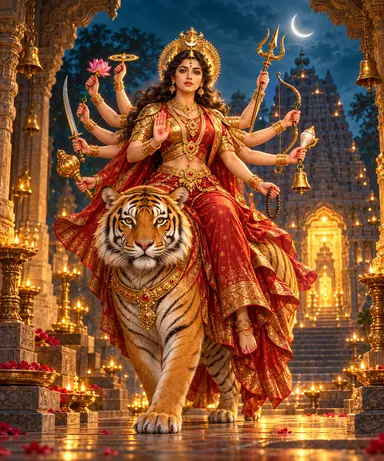
The Goddess’s bell comes from Airavata in the wider Mahisha narrative.
Stories & Events1

The Bhagavata places Airavata’s emergence in Samudra Manthana.
Earthly Sacred Locations1

Airavata carries Indra to the Govardhana meeting with Krishna.