01From Listening Child to Traveling Sage
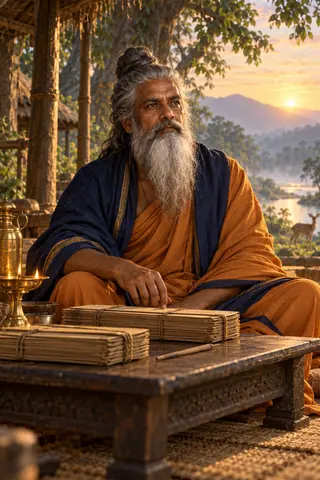
In the Bhagavata, Narada tells Vyasa that, in an earlier life, he was the son of a woman serving learned ascetics. During their rainy-season stay he served them and listened to their accounts of Krishna. Spiritual transformation begins with attentive association and hearing, rather than with inherited status or military power.
The story continues after his mother's death from a snakebite. The child travels north, passes through inhabited and wild places, and meditates in a forest. A momentary vision of the Lord is followed by its disappearance, deepening his longing. Narada later describes his unrestricted travel and the vina with which he sings. In this account, the famous celestial messenger's own formation includes dependence, loss, perseverance, and the discipline of remembrance.
02A Teacher Who Responds to Dhruva
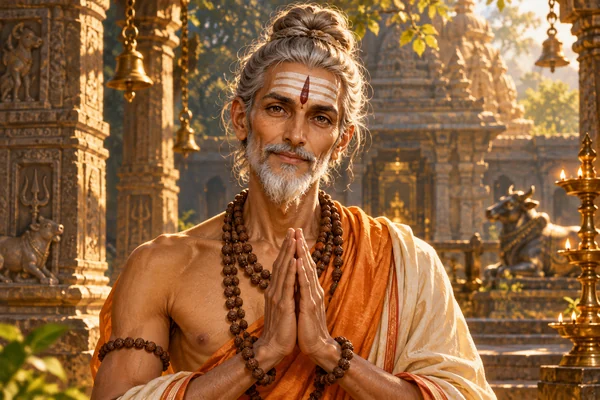
When the young Dhruva leaves home after an insult, Narada first urges him to reconsider his wounded pride and the difficulty of severe spiritual practice. Dhruva's determination leads to more specific instruction. Narada describes meditation, worship, available forest offerings, and the mantra, a sacred invocation, addressed to Vasudeva, a name of Vishnu. The exchange presents teaching as responsive: he neither merely flatters the boy's anger nor abandons him because his first motivation is mixed with ambition.
03Protecting Kayadhu and Instructing Prahlada
The Bhagavata recalls Indra taking the pregnant Kayadhu, Prahlada’s mother, into custody during conflict with the asuras. Narada intervenes, declares her innocent, and identifies the unborn child as a great devotee. Indra releases her; Narada gives her refuge in his hermitage. Prahlada says that he heard the instruction given there while still in the womb. Narada's protection thus crosses the boundary between deva and asura families: devotion and innocence matter more than the mother's political affiliation.
04Questioning Vyasa's Dissatisfaction
Narada encounters Vyasa after the sage's extensive literary work has failed to bring him fulfillment. In the Bhagavata's explanation, Narada identifies a lack of sufficient attention to the direct praise of Vasudeva, the divine Lord. His intervention leads toward the composition and teaching of the Bhagavata. The story makes him an adviser to an already accomplished teacher, rather than merely a supplier of information to the uninformed.